Videos
Click on the thumbnails to see the video.
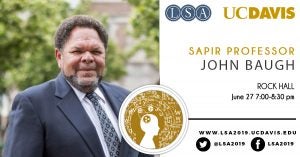 |
John BaughSapir Professor |
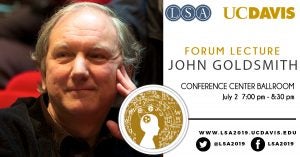
John GoldsmithForum Lecturer |
 |
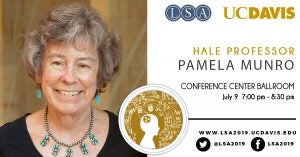 |
Pamela MunroHale Professor |
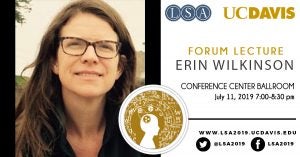
Erin WilkinsonForum Lecturer |
 |
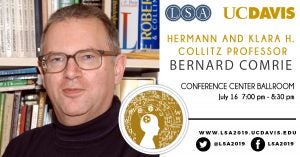 |
Bernard ComrieHermann and Klara H. Collitz Professor |
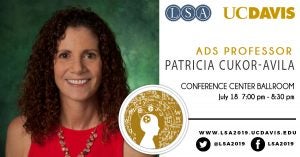
Patricia Cukor-AvilaADS Professor |
 |
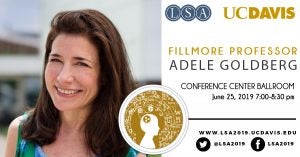 |
Adele GoldbergCharles Fillmore Professor(Due to recording errors, we are missing Professor Goldberg’s video (the very first talk in the series). We apologize for the inconvenience, especially to Professor Goldberg and to those who have been waiting to watch her amazing talk.) |
Brian JosephLSA PresidentClosing Ceremony Speech |
 |
 |
Raul AranovichCo-directorClosing Ceremony Speech |
Franco LiuIvan Sag FellowClosing Ceremony Speech |
 |
Information
While all events are open to students/affiliates and faculty who are officially enrolled in the Institute, we also have several lectures open to the general public. These are indicated in the table below. Note that all receptions are limited to individuals who have paid for registration or are already involved in the Institute in an official capacity.
| Date | Lecture/Reception | Location | Time |
|---|---|---|---|
| June 24 | Opening Reception *Only for Institute participants | Conference Center Ballroom ABC | 7:00 - 9:00pm |
| June 25 | Lecture: Adele Goldberg (Fillmore Professor) *Open to the public | Conference Center Ballroom ABC | 7:00 - 8:30pm |
Explain me this: children are both more conservative and more ready generalizers for the same reason There is a lot of evidence that children are “conservative” in that they do not generalize the language they hear to the same extent as adults. And yet there’s also work that reports that children generalize (“regularize”) even more than adults. This presentation will address this apparent paradox and argue that both effects stem from the same process: failure to access the best (combination of) constructions and instead producing a “good-enough” option. The challenge children face stems from their need to gain fluency with a rich network of constructions that are conditioned by a wide array of rich conceptual, contextual, and social factors. |
|||
| June 27 | Lecture: John Baugh (Sapir Professor) *Open to the public | Rock Hall | 7:00 - 8:30pm |
This presentation begins with a brief tribute to Edward Sapir and his multifarious contributions to the creation of linguistic science. His documentation of Takelma and other Native American languages represents an early manifestation of linguistic benefaction. Sapir (1921) also asserted that, “The English language is not spoken by a unified race. In the United States there are several millions of negroes who know no other language. It is as much their property, as inalienably “theirs,” as the King of England’s.” (Chapter 10: Section 3). Sapir’s linguistic advocacy is illustrative of ways in which some linguistic findings have helped to promote social equality and linguistic human rights. Other depictions of English usage diversity are embodied in Labov’s (1966) analyses of The Social Stratification of English in New York City, which provided some of the evidence used to debunk myths regarding the cognitive, educational and linguistic inferiority of African Americans (see Jensen 1969, Labov 1969a). By capitalizing on conceptual advances in theoretical linguistics, Labov (1969b) was able to develop analytical tools that were eventually utilized for legal purposes; that is, to advance racial equality in education, fair housing, employment, as well as a combination of civil and criminal cases where linguistics served to promote equal justice under the law. Rickford and King (2016) expanded upon these efforts in their fastidious accounts of language usage evaluating racist depictions of Rachel Jeantel during the George Zimmerman murder trial, and in so doing they demonstrated another instance of just linguistics in action. Smalls (2004) accentuates some of the legal challenges for those who wish to examine the ways in which victims of linguistic profiling can seek legal adjudication in the courts. Her efforts are echoed by Zentella (2014) who exposes linguistic bigotry in the workplace against native speakers of Spanish. This presentation will also describe a combination of other civil and criminal cases where linguistic analyses and experimentation proved crucial to the pursuit of justice. The discussion concludes with an uplifting depiction of efforts to defend an African American defendant, a single mother, who was unfairly accused of a crime that demanded linguistic relief. |
|||
| July 2 | Forum Lecture 1: John Goldsmith *Open to the public | Conference Center Ballroom ABC | 7:00 - 8:30pm |
Linguistics in the Digital Era We all know that we are doing linguistics in the digital era, but exactly where are we, and how did we get here? The digital era offers us fabulous conveniences, from email to skype to Praat, and the digital era allows linguists to ask new questions about large and small corpora, and about the complexity of competing hypotheses. I will recount three stories that reflect on our past and our present. The first involves the sometimes uneasy relationship between general linguistics and computational linguistics. Both camps are deeply interested in how language can be learned, and yet advances for one group rarely seem to be viewed as advances by the other. Why is that? Is there anything wrong with it? What can be learned from it? The second story is that of the origins of the two styles of computation. There's the familiar style of computing (often called the von Neumann model) that is used in 99% of all computation today, and then there's the less familiar style based on neural networks. This latter approach has gone through four generations, the last of which involves deep learning, and there has been great excitement and accomplishment in treating language using these models. Should linguists share this excitement? The third story takes us back a bit in time, but is none the less interesting for that. Much of our modern ideas about computing by machine grew out of worries about the foundations of mathematics and science. At the turn of the last century, the mathematician David Hilbert urged scholars to study the essential nature of proof, and to ensure that disciplines could be responsibly fit together to provide a unified understanding of the world. Hilbert's ideas led both to (1) the creation of imaginary computers (Alan Turing's imaginary machine, and Emil Post's imaginary postal worker) which in time turned into real computers, and (2) logical positivism in the 1930s. Emil Post's work was instrumental in Chomsky's advances over Zellig Harris's work, and the logical positivists (Carnap, Reichenbach) came to the conclusion that formal syntax may not yet exist, but it is essential to our future, and it may be simply too important to leave to the linguists! These are three stories that linguists ought to know about. |
|||
| Forum Lecture Reception *Only for Institute participants | AGR Hall - Moss Patio | 8:30-10:00pm | |
| July 9 | Lecture: Pamela Munro (Hale Professor) *Open to the public | Conference Center Ballroom ABC | 7:00 - 8:30pm |
Agreement and Disagreement in Garifuna Garifuna (also called Central American Island-Carib and Black Carib; iso code cab) is an indigenous American language of the Arawak(an) family spoken in Belize, Honduras, Nicaragua, and Guatemala, and by a large diaspora population in the United States (described in Munro et al. 2017, Haurholm-Larsen 2016, and many works by Douglas Taylor). In previous work (1997, 2013) I have shown that Garifuna has gender and other agreement in an unusually wide variety of morphosyntactic contexts, for instance, when considered with regard to Corbett's extensive typology of gender (1991). Verb phrases, possessed nouns, prepositions, demonstratives, certain adjectives, and other more exotic sentence elements show agreement by means of various affixe sets (here S, P, D), with verb stem types (here shown as "verb:A/P/B") varying by construction. The relational opposition shown may be ergative, as in certain conditional clauses (1), with suffixed absolutive agreement on 'if' and ergative marked with a prefix, or accusative, as in progressives (2), where the same prefix marks nominative and accusative is shown with a suffix on the incompletive auxiliary: 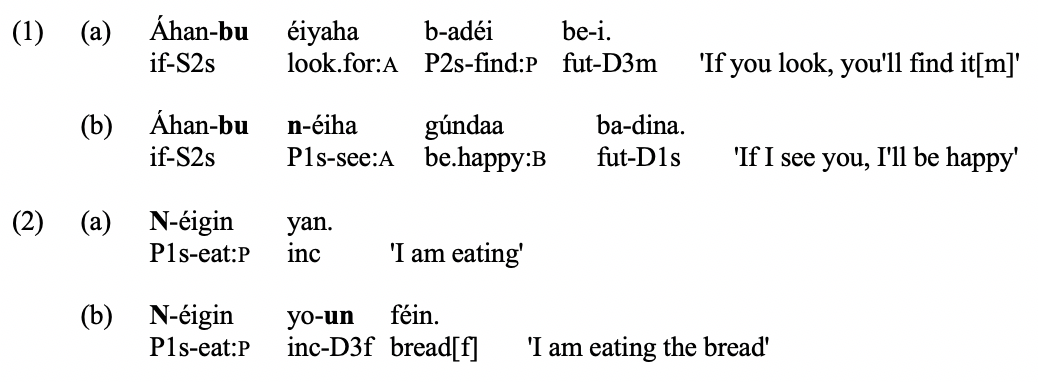 In other constructions, active/non-active (stative) features are relevant. In this talk I will look at less typical types of agreement and non-agreement: possessor raising, expletive agreement, various cases of default agreement (influenced in part by Garifuna's opposition between neutral and men's speech), and complete lack of agreement, especially in complex extraction contexts. |
|||
| July 11 | Forum Lecture 2: Erin Wilkinson *Open to the public | Conference Center Ballroom ABC | 7:00 - 8:30pm |
Typological markedness in signed languages: A cross-linguistic study on kinship terminology Nearly all such studies have sought to understand the linguistic constraints of spoken languages, while largely neglecting signed languages. Despite the fact that spoken languages can be classified into types, signed languages are generally assumed to be clustered all together in one type which current literature challenge. Exploring the potential for a varied typology among signed languages requires identifying patterns across a sampling of geographically distinct and historically unrelated signed languages to formulate linguistic generalizations. Older typological studies compared macro signed languages (e.g. urban signing varieties in developed countries) and found evidence of systematic variation at all levels of linguistic description. Furthermore, recent studies on underdocumented and underdescribed micro signed languages (e.g. rural sign languages) reveal interesting linguistic patterns that differ from major signed languages. Differences in typological patterns in macro and micro signed languages are observed in handshape variation (phonology), word order, negation, use of space (morphosyntax), and semantic domains of number, color terms, and kinship terms (lexicon) (de Vos & Pfau, 2017; Nyst, 2012; Zeshan, 2004; Zeshan & de Vos, 2012). In my talk, I will discuss my study on kinship terminology in 40 signed languages, which is based on Greenberg’s 1966 analysis of Universals of Kinship Terminology. The cross-linguistic investigation of the relationship between phonological structure and semantic domains reveal different linguistic processes in kinship terminology. Kinship terminology in macro signed languages are larger and more structurally complex compared to micro signed languages. Numerous kin terms appear to be schematized by physiobiological human traits, universal human cognitive experiences, and cultural-specific properties, and those schemas may account for a high incidence of lexical similarity in signed languages. The study also finds evidence of variation in grammatical marking of gender, age of referent, and generation that are expressed by different linguistic processes. Out of 40 signed languages, 25 signed languages’ kin terms were produced with initialized handshapes, fingerspelling, and character-writing, leading to several findings. This finding illustrates not only influence from their surrounding spoken and written languages, it also reflects similar cultural distinctions in kin systems made in the majority hearing communities – underscoring social factors at play in signing communities. This particular linguistic process to kin terms appears to be more common than traditionally assumed. Manual representations of spoken/written languages are traditionally viewed as more marked than forms that do not have any initialization overlap. However, several languages’ nuclear kin terms (e.g. mother, father, sister, and brother) are expressed with initialized handshapes while their more distant kin terms are produced with no initialized handshapes. This finding suggests that the organization of signed language kinship terminology systems may not parallel to what Greenberg found for spoken languages. Since traditional definitions of marked and unmarked categories in spoken languages’ kinship terminologies defined by Greenberg cannot be fully applied to signed languages’ kinship terminologies, it is crucial for us to revisit the question about typological markedness in signed languages’ kin terms— which the talk will address in depth. |
|||
| Forum Lecture Reception *Only for Institute participants | AGR Hall - Moss Patio | 8:30-10:00pm | |
| July 16 | Lecture: Bernard Comrie (Hermann and Klara H Collitz Professor) *Open to the public | Conference Center Ballroom ABC | 7:00 - 8:30pm |
Great Andamanese, one of the two indigenous language families of the Andaman Islands, comprises ten traditional varieties, all extinct, plus Present-day Great Andamanese, a descendant primarily of one of these languages remembered by a handful of indigenous people. Documentation of the traditional varieties was very limited and carried out exclusively by non-linguists. Despite this unpromising state of affairs, joint work with Raoul Zamponi has not only uncovered much of the synchronic structure of the traditional varieties but also laid the groundwork for comparative-historical studies. The lecture will set out what we know, what we might hope to find out through future work – and what may lie forever beyond our grasp. |
|||
| July 18 | Lecture: Patricia Cukor-Avila (ADS Professor) *Open to the public | Conference Center Ballroom ABC | 7:00 - 8:30pm |
Linguistic Insights from a Longitudinal Panel Survey of African American English 1988-2018 In this presentation I report on a panel survey conducted between 1988-2018 in the rural community of Springville, Texas. The Springville panel survey evolved out of the larger survey of the community that was designed to document both the evolution of African American Vernacular English (AAVE) and to explore fundamental issues of language change. This survey includes interviews with 97 people – 62 African Americans, 23 Anglos, and 12 Mexican Americans, a distribution that roughly parallels the historical ethnic make-up of Springville. The oldest community member recorded was born in 1894 and the youngest in 2002, providing an apparent time perspective of more than a century. The Springville panel survey includes interviews over thirty years with eighteen people (roughly a third of those in the larger survey) born between 1912 to 1996; many of them were interviewed multiple times per year in a variety of interview contexts (individual, peer group, site study, and recordings in which individual panelists were the fieldworkers), and with a wide range of interlocutors (44 total including the two fieldworkers) of different ages and ethnicities (Anglo, Latino, African American). This presentation presents data from the panel survey that address issues such as transmission and diffusion of linguistic features, age-grading, style shifting, and language over the lifespan |
|||
| Closing Reception *Only for Institute participants | Conference Center Ballroom ABC | 8:30 - 10:00pm | |